Platform Guide

Getting Started with Ask Sage

Master the Ask Sage Chat interface and unlock the full potential of AI-powered interactions
Ask Sage User Interface Overview
Your Journey Begins: This guide will walk you through the Ask Sage Chat User Interface, helping you understand each component and feature. Mastering these fundamentals is crucial to generating optimal results for your use cases.
Table of Contents
  1. User Interface (UI)
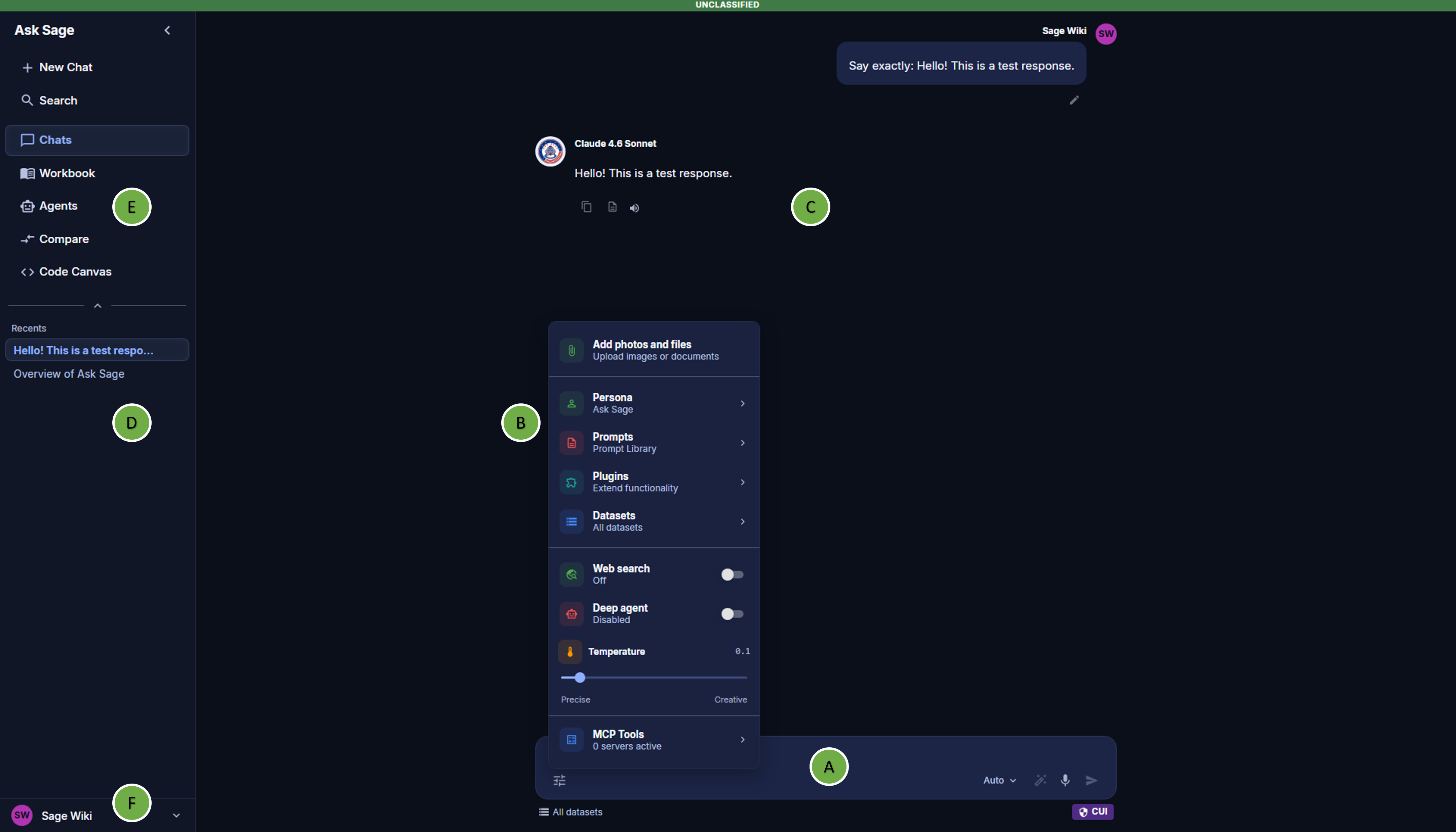
    1. Prompt Window - A
    2. Tools menu - B
    3. Inference Window - C
    4. Chat History - D
    5. Sidebar Menu - E
    6. Sidebar Menu - F
  2. Summary

User Interface (UI)

Ask Sage Platform Overview

The Ask Sage platform is designed to be user-friendly for organizations and their users to interact with GenAI models. The UI is divided into five main sections: Prompt Settings, Prompt Window, Inference Window, Chat History, and Side Bar Menu.


Prompt Window - A

Prompt Window

Ask Sage Prompt Window Interface

This is where users can enter a prompt, which is like a question, query or set of instructions/commands they want the model to follow in order to generate a response. The prompt window includes several interactive features to enhance user experience:

Attachment Button

Upload files such as images and documents. Enables text generation based on the content without storing in the dataset.

Tools menu

Access comprehensive prompt configuration options and settings.

Model Selection

Select from a variety of models available on the platform for different functionalities.

Enhance Prompt

Refines and optimizes inputs to improve clarity, context, and specificity for better responses.

Microphone Button

Generate text using voice input, making prompt creation easier without typing.

Click the microphone and allow microphone access if your browser asks. While recording, the prompt box shows a red stop button, a live level meter, and the elapsed time. Click Stop recording to turn your speech into text in the prompt box.

Prompt box while recording, with a Stop recording button, level meter, and elapsed time

Enhance Prompt

Type a short prompt, then click the Enhance prompt (wand) icon next to the microphone:

Prompt window with a short prompt and the Enhance prompt tooltip on the wand icon

Ask Sage rewrites your prompt in place with more detail, structure, and context. Review or edit the rewritten prompt before you send it:
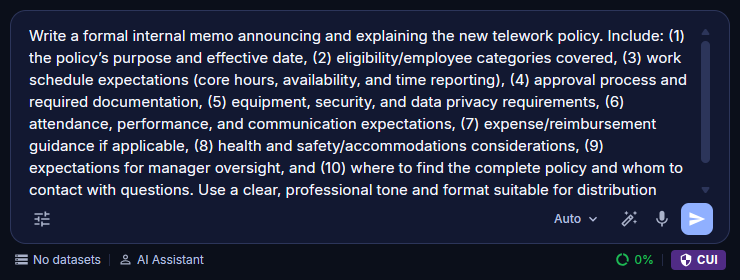
Prompt window showing the enhanced, more detailed version of the prompt
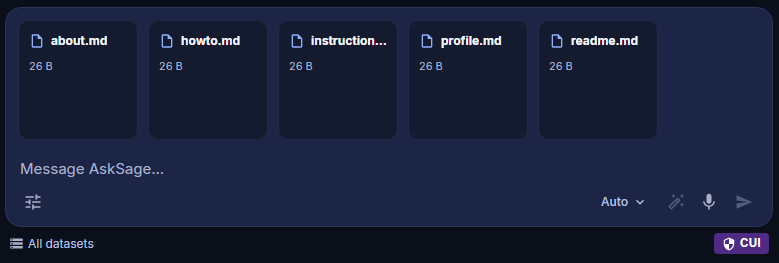
Multiple File Support: The platform supports uploading 5 files simultaneously. Please note that you are still subject to the context window limitations of the model in use.
Multiple File Attachment Interface

Tools menu - B

Prompt Tools & Configuration

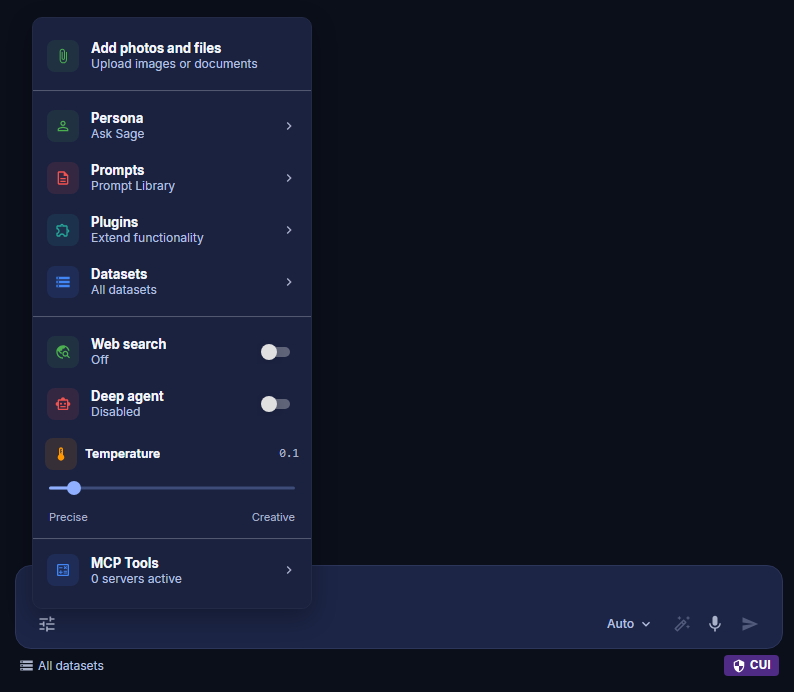
Ask Sage Hyperparameters Configuration

Here users can set the various features for a prompt. This includes Adding photos and files, Persona, Prompts, Datasets, Web search, Deep agent, Temperature, and MCP tools they want to reference or activate for the prompt.

Learn More: In the following Prompt Features section, we will explain each of these features in detail.

Inference Window - C

Inference Window

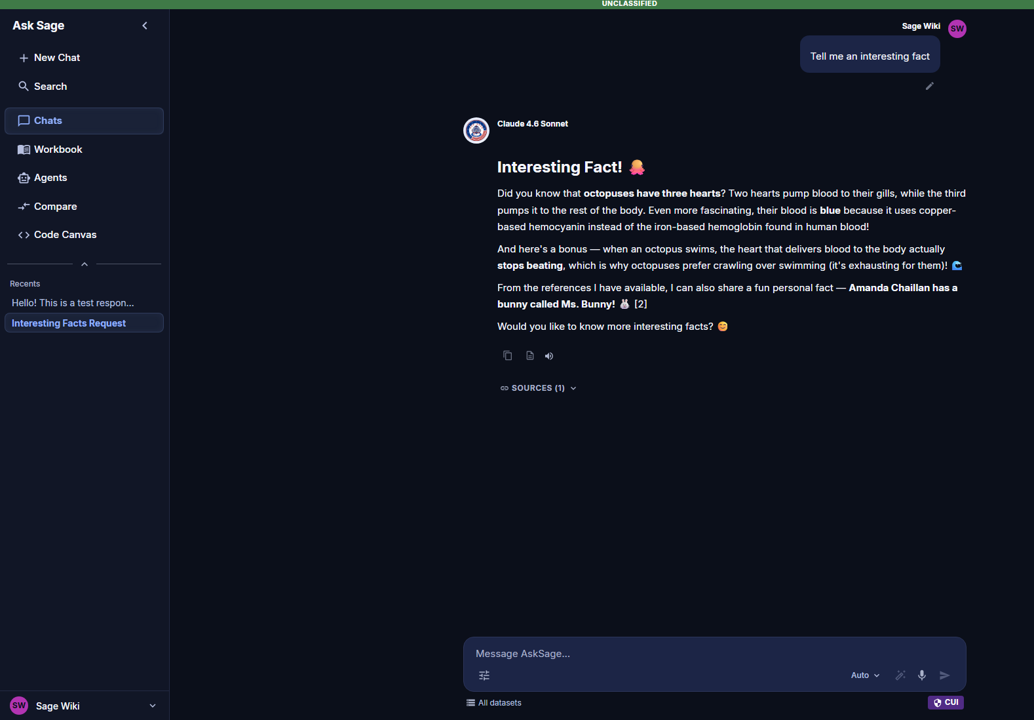
Ask Sage Inference Window

This section displays the text generated by the model. The name of the model that answered appears above each response. After each response, users will see additional questions or follow-up prompts to continue the conversation.

While the model is working, the response shows a Thinking… indicator, and the chat in Recents shows an animated indicator next to its name. Long-running responses also show elapsed time and updated status messages.
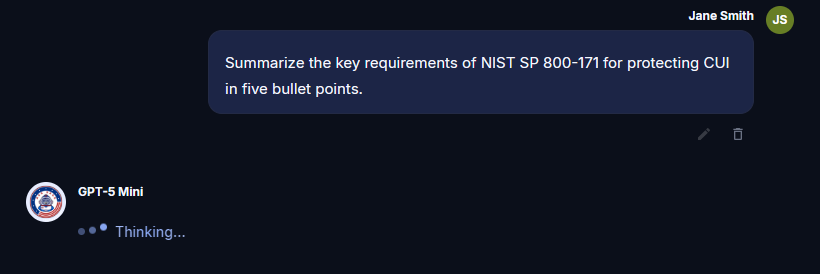

Chat response area showing the model name GPT-5 Mini and a Thinking indicator below it
Long-running response showing Still thinking, this one needs a moment, with 0:30 elapsed
Quick Access: You can access 'Copy', 'Save as DOCX', 'Delete', 'Read aloud', and 'Response provenance' located below the response generated.
Response toolbar with Copy, Save as DOCX, Delete, Read aloud, and Response provenance icons
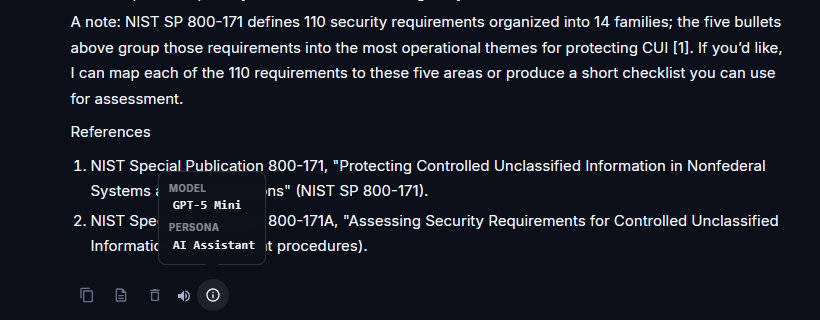
Response Provenance: Click the Response provenance (ⓘ) icon below a response to see what produced it: the Model, the Dataset(s) actually queried, the Persona, and the agent, when one was used. Saved conversations keep this information. The ⓘ button at the bottom right of the chat hides or shows provenance for the whole conversation, and you can turn it off by default in Settings → Appearance.
Response provenance popover showing Model GPT-5 Mini and Persona AI Assistant
Conversation Context: The token badge in the bottom-right corner of the chat window opens the Conversation Context panel, showing how much of the current model's context window your conversation is using. This is not your token balance — see Conversation Context for a full breakdown.

Chat History - D

Chat History Management

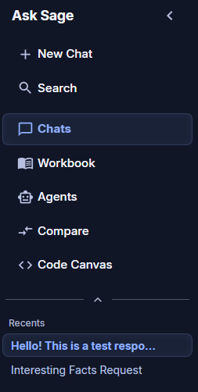
When users engage with models in Ask Sage Chat, their interactions occur within a chat session. All chat sessions are saved and listed under Recents in the sidebar, and can be accessed by users at a later time. Recents also lists your recent code canvases, agents, and workbooks, each marked with its own icon, so you can jump back into any of them from one place. Please note that the names of chat histories are automatically generated based on the initial prompt entered.
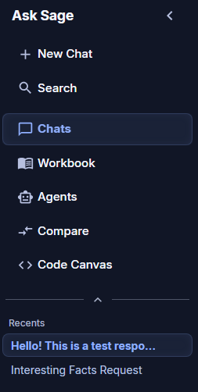
Sidebar Recents list showing chats, code canvases, agents, and workbooks
Chat Search: Click Search in the sidebar to search across your chats, code canvases, agents, and workbooks from one place. Results are grouped by type. Search matches titles only; message and file contents are not searched.

Users can copy an entire chat history, rename a chat session, share it with members from the same organization, and delete it if they no longer need it within the User Interface. These options are available via the three dots next to the chat session name.

Manage Chats
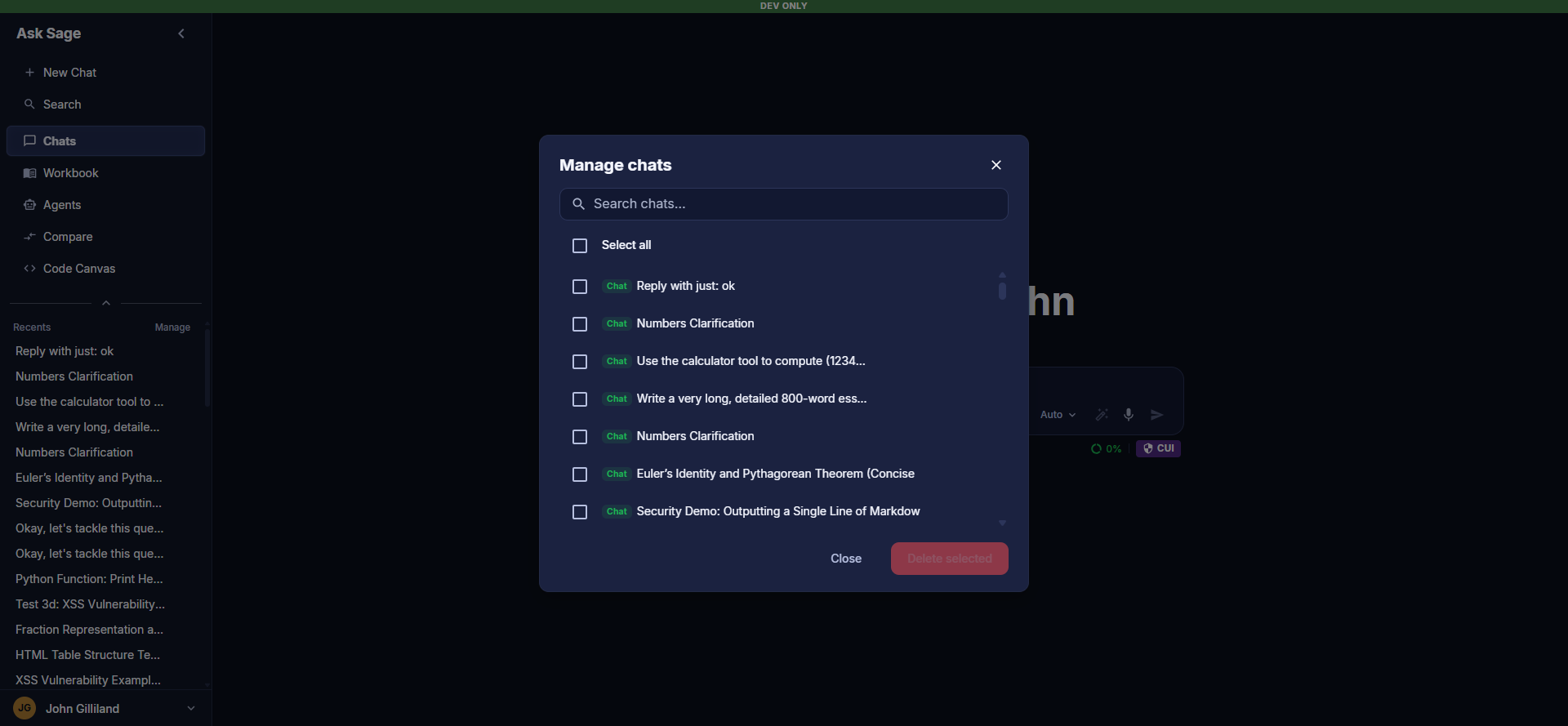
Manage chats dialog with search, select all, and delete selected

Click Manage above the Recents list to open the Manage chats dialog for bulk cleanup. Search for chats by title, use Select all or check individual chats, then click Delete selected to remove multiple chat sessions at once.

Privacy Notice: The chat history can only be accessed by the user who created it. However, users can share their chat history with other members of the same organization. Users are not allowed to share their chat history with users from other organizations.
Best Practice: Always initiate a new chat session when changing topics or contexts. Continuing a session with a different subject can hinder the model's ability to generate accurate results. Additionally, if you encounter issues with the model, starting a new chat session may help resolve them, as prior chat history could influence the model's responses.

Sidebar Menu - Platform Features

Sidebar Menu Section E

In the sidebar menu, users can use the options to navigate the platform and access additional products paid subscriptions will have access to:

  • New Chat - Start a fresh conversation with a blank context
  • Search - Search your chats, code canvases, agents, and workbooks by title
  • Chats - The main user interface for interacting with Ask Sage Chat
  • Workbook - Engage with GenAI models in a more intuitive manner
  • Agents - Create an Agent and a multi-step workflow
  • Compare - Evaluate and compare the outputs of different models
  • Code Canvas - Chat with an LLM to write code
Integrations: Connecting Ask Sage to your IDE, terminal, and other platforms is now configured from Account Settings → Integrations rather than the sidebar.
Continuous Innovation: We are constantly updating the platform and adding new products, so stay tuned for more exciting features and tools to come!

Sidebar Menu - Account & Support

Sidebar Menu Section F

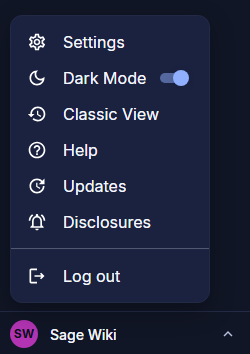
The bottom of the sidebar provides access to support and your account:

Learn More: See the Account Settings section for a full walkthrough of each option.
  • Settings - Configure your account preferences and platform settings
  • Models - View the models enabled for your tenant, with context size and token conversion rates
  • Dark Mode - Toggle between dark and light interface themes
  • Help - Access documentation, tutorials, and support resources
  • Updates - View the latest platform updates and release notes
  • Disclosures - Review important notices and compliance disclosures
  • Admin Panel / Super Admin - Shown only to administrators; opens the administration console
  • Log out - Sign out of your Ask Sage account

The bottom of the menu shows the client and server version you are running.

Learn More: In the following Account Settings section, we will explain each of these features in detail.

Summary


Back to top

Copyright © 2026 Ask Sage Inc. All Rights Reserved. Ask Sage is a BigBear.ai company.